







What Your Sleeping Position as a Couple Actually Reveals

This content is for informational purposes only and does not constitute medical advice. Consult a healthcare professional for personal guidance.
Key Takeaways
- Sleeping positions reflect comfort preferences more than relationship health, but they do carry useful information
- Physical contact during sleep correlates with higher reported relationship satisfaction in studies
- Sleeping positions naturally evolve throughout a relationship and are not fixed indicators
- Practical factors -- temperature, mattress size, snoring -- influence position far more than psychology
- The best sleeping arrangement is whatever allows both partners to sleep well
There is a quiet intimacy to sleep that we rarely discuss. During waking hours, our bodies are consciously managed -- we choose our postures, control our expressions, maintain appropriate distances. But in sleep, the conscious mind steps aside. What remains is the body's unfiltered relationship with the space, the bed, and the person beside you.
This is why couples' sleeping positions have fascinated both researchers and casual observers for decades. The idea that your unconscious body arrangement might reveal something true about your relationship is irresistible. And while the pop-psychology interpretations tend toward the dramatic -- "sleeping back-to-back means your relationship is in crisis!" -- the actual research tells a more nuanced and ultimately more useful story.
Let us walk through the most common sleeping positions, what the evidence (not the internet) actually says about each, and why the position that matters most is the one that lets both of you wake up rested.
The Classic Spoon
The big spoon wraps around the little spoon, bodies fitted together like puzzle pieces. This is the position most associated with romance, and research partially supports the association. Couples who spoon tend to report high levels of relationship satisfaction and physical intimacy. The position requires trust -- the little spoon is literally in a vulnerable, enclosed position -- and it releases oxytocin through sustained skin contact.
But there is a practical dimension the romance narrative misses: spooning is hot. Literally. Two bodies pressed together generate significant heat, which makes this position more common in the early months of a relationship (when the desire for closeness overrides the desire for thermal comfort) and less common as relationships mature and people prioritise sleep quality.
What it suggests: Comfort with physical closeness and a desire for protection (from the big spoon) or security (from the little spoon). Common in newer relationships and during periods of high emotional connection.
Who Is the Big Spoon?
Gender stereotypes suggest the man is always the big spoon. Research says otherwise. In many couples, the roles rotate naturally based on who falls asleep first, who is seeking comfort, or simply who is cooler in temperature. Some couples report that the partner who is feeling emotionally stronger on a given night naturally gravitates toward the big spoon position. It is a form of wordless care.
Back-to-Back, Touching
Both partners face outward but their backs, bottoms, or feet maintain contact. Sleep psychologists consider this one of the healthiest positions, and here is why: it combines independence with connection. Each person has their own space, their own breathing room, their own comfortable arrangement, but the physical contact -- even a single point of touch -- maintains the couple's bond through the night.
What it suggests: A secure, established relationship where both partners feel confident enough to face outward without anxiety about disconnection. This position is most common among couples who have been together for more than a year and report high satisfaction.
Back-to-Back, Not Touching
This is the position that generates the most anxiety when people encounter it in a magazine quiz. The assumption is that space equals disconnection. The reality is more generous.
Many couples who sleep apart in bed are simply practical sleepers. They run hot. They move a lot. They have different mattress firmness preferences. One of them snores. The absence of touch during sleep is not a relationship barometer -- it is a sleep quality optimisation.
That said, if this position represents a change from a previously more connected sleeping arrangement, it is worth noting. Sudden shifts in sleeping position can reflect emotional changes. The key question is not "are we touching?" but "do both of us feel good about our sleeping arrangement?"
What it suggests: Could indicate secure independence, practical sleep preferences, or -- if it represents a sudden change -- emotional distance worth addressing during waking hours.
Face-to-Face
Partners face each other, sometimes with limbs intertwined, sometimes with a small gap. This is the most intimate sleeping position in terms of vulnerability -- your faces are close, your breath mingles, your expressions are visible even in dim light. It is also the rarest position for actual sustained sleep because breathing into each other's faces is not particularly conducive to rest.
Couples who fall asleep face-to-face often shift to another position during the night. The face-to-face arrangement is more commonly a pre-sleep position -- a moment of connection before sleep takes over -- than an all-night configuration.
What it suggests: Deep emotional intimacy, a desire for connection, and often a relationship in a phase of intense bonding (new relationship, reconciliation after conflict, or a period of renewed closeness).
The Tangle
Arms and legs intertwined, bodies pressed close, a configuration that would make an orthopaedic surgeon wince. The tangle is overwhelmingly associated with new relationships, particularly the first six months. It expresses a desire to merge, to be as close as physically possible, to dissolve the boundary between two bodies.
If you are still sleeping in the tangle after years together, it may indicate high passion but also potentially a codependent dynamic. The healthiest relationships typically evolve from the tangle toward positions that balance closeness with individual comfort.
What it suggests: Intense passion and emotional intensity. Common in early relationships. If sustained long-term, may indicate difficulty with individual boundaries.
The Starfish and the Satellite
One partner sprawls across the bed while the other curls into whatever space remains. This asymmetry shows up in many relationships and often reflects personality dynamics more than relationship health. The starfish is typically the more dominant or unconsciously space-claiming partner; the satellite is the more accommodating one.
If both partners are content with this arrangement, it is perfectly fine. If the satellite consistently feels squeezed out or resentful, the sleeping position may be mirroring a larger dynamic in the relationship that deserves attention.
What it suggests: Asymmetry in space-claiming behaviour. Worth examining if one partner feels consistently accommodating in other areas of the relationship as well.
What Actually Matters More Than Position
Sleep researchers are increasingly clear that the specific position matters less than whether both partners are sleeping well. Sleep deprivation is one of the most reliable predictors of relationship conflict. Couples who sleep poorly together report more arguments, less intimacy, lower empathy, and decreased relationship satisfaction.
This means that the most loving thing you can do for your relationship might be acknowledging that your partner's snoring requires a practical solution, or that a king-size bed would benefit your connection more than forcing closeness on a double.
In India, where many couples share beds that are smaller than ideal due to space constraints in urban apartments, the practical dimension is particularly important. If you are sleeping on a standard double bed, you have roughly 68 centimetres of width per person. That is less than a single bed. No wonder you end up in a back-to-back configuration -- you are simply making space for each other to exist.
The Before-Sleep Ritual Matters More
What you do in the fifteen minutes before falling asleep predicts relationship satisfaction more reliably than any sleeping position. Couples who use this window for connection -- talking, touching, reading together, or simply being present without screens -- report significantly higher intimacy than those who scroll their phones independently until sleep comes.
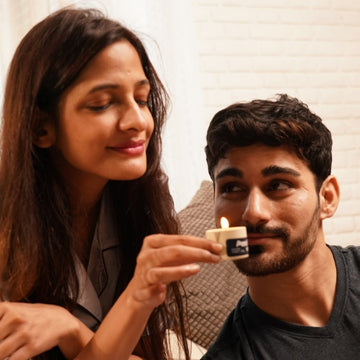
Consider turning this pre-sleep window into a sensory ritual. A brief massage with something like MyMuse Glow Relaxing Massage Oil (₹499), even just on hands and feet, serves triple duty: it provides skin-to-skin contact that triggers oxytocin, the aromatherapy promotes relaxation, and the act of caring for each other's bodies is itself a form of intimacy that requires no further escalation.
When Sleeping Positions Change
The most useful information from sleeping positions comes not from any single configuration but from changes over time. If you have spooned for years and suddenly find yourselves on opposite edges of the bed, that shift carries meaning. If you have slept apart and now find yourselves gravitating closer, that also says something.
Pay attention to the transitions. They often precede -- or accompany -- emotional shifts that you may not have consciously registered yet. Your sleeping body sometimes knows things before your waking mind catches up.
Frequently asked questions
Does not touching during sleep mean our relationship is in trouble?
Not necessarily. Many healthy, happy couples sleep without touching due to temperature preferences, movement during sleep, or mattress size. The better indicator is whether you feel connected during waking hours and whether the sleeping arrangement satisfies both partners. If the lack of contact bothers one of you, that is worth discussing, but it is not an automatic red flag.
We used to spoon every night but now we don't. Is that normal?
Completely normal. Most couples shift from high-contact sleeping positions in the early relationship to more independent arrangements as the relationship matures. This reflects comfort and security, not disconnection. If you miss the closeness, try incorporating a few minutes of intentional cuddling before sleep, then allowing yourselves to settle into comfortable individual positions.
Is it okay for couples to sleep in separate beds?
Absolutely. Sleep scientists increasingly support the idea of separate sleeping arrangements when co-sleeping results in poor sleep for one or both partners. Chronic sleep deprivation damages relationships far more than separate beds do. What matters is maintaining intentional intimacy during waking hours and ensuring the separate sleeping arrangement is a mutual, discussed decision rather than an avoidance strategy.
Can changing our sleeping position improve our relationship?
Changing your sleeping position intentionally is less likely to improve your relationship than changing your pre-sleep routine. Adding a few minutes of connection -- conversation, touch, a shared ritual -- before sleep has far more impact than trying to force a particular physical arrangement during sleep, when you have limited conscious control.
- Research-backed insights from sleep psychologists
- Practical advice for Indian living situations
- Trusted by 3.75L+ readers across India
- Editorially independent content
Designed for Real Bodies
A relaxing pre-sleep massage can deepen your connection and improve your rest. Explore MyMuse's range of massage oils and personal wellness products.
Browse ProductsLast updated: April 2026
Prices checked on 03 Oct 2026 on mymuse.in.