







How Body Image Issues Quietly Destroy Your Intimacy (And What to Do)

This content is for informational purposes only and does not constitute medical advice. Consult a healthcare professional for personal guidance.
Key Takeaways
- Body dissatisfaction is the leading reason people avoid or disengage from intimacy
- During intimacy, a phenomenon called "spectatoring", watching yourself from the outside, blocks arousal and pleasure
- Body image issues affect all genders, though they manifest differently
- Cognitive behavioural strategies can interrupt the self-critical loop that derails intimate experiences
- Partners who explicitly communicate desire for their partner's body help counteract internalised shame
You are undressing in front of someone, and instead of being present in the moment, feeling their touch, registering their desire, experiencing the warmth of connection, your brain has become a surveillance camera. It is cataloguing every perceived flaw: the stomach that is not flat enough, the stretch marks, the body hair you missed, the way your thighs look in this lighting. You are simultaneously in the room and watching yourself from the outside, and the self-criticism is drowning out everything else.
This is not vanity. It is not superficiality. It is a phenomenon that psychologists call "spectatoring", the tendency to observe and evaluate your own body during intimacy rather than experiencing the intimacy itself. And it is remarkably common. Research from the University of British Columbia found that body image concerns are the single strongest predictor of sexual avoidance and dissatisfaction, outranking relationship quality, hormonal factors, and physical health.
How Body Image Disrupts Intimacy
The Spectatoring Loop
When you are focused on how your body looks, you cannot simultaneously focus on how it feels. The brain's attention is finite. Every neural resource devoted to self-surveillance is a resource unavailable for processing pleasure. This is why people with body image concerns often report "going through the motions" during intimacy. Their body is present, but their mind is elsewhere, performing an audit.
Avoidance Behaviours
Body dissatisfaction leads to predictable avoidance patterns:
- Insisting on darkness or keeping clothes on
- Avoiding certain positions that feel "exposing"
- Redirecting attention to the partner's pleasure to avoid focusing on one's own body
- Declining intimacy altogether by claiming tiredness or headaches
- Rushing through intimacy to limit exposure time
Each of these behaviours reduces the quality and frequency of intimate experiences, which over time can strain relationships and reinforce the belief that your body is a barrier to connection rather than a vehicle for it.
Gender Differences
Body image issues affect all genders, but the specifics differ:
- Women most commonly report concerns about weight, stomach, thighs, and breast appearance. Cultural messaging about the "ideal" female body is relentless and narrow, and its impact on intimate confidence is well-documented.
- Men most commonly report concerns about muscularity, penis size, body hair, and height. Male body image issues are often dismissed or minimised, which means they go unaddressed for longer.
- Non-binary and trans individuals may experience body dysphoria that adds additional layers of complexity to intimate body image.
What Actually Helps
Sensate Focus Exercises
Developed by Masters and Johnson, sensate focus involves taking turns touching each other's bodies with the explicit instruction to focus on sensation rather than outcome. No pressure toward arousal or orgasm, just deliberate, mindful touch. This retrains the brain to associate the body with pleasure rather than appearance.
Cognitive Restructuring
When the self-critical voice starts during intimacy, practice noticing and redirecting:
- Notice: "I am thinking about how my stomach looks right now."
- Name it: "That is the body image critic. It is not helpful."
- Redirect: Focus on a specific physical sensation: the warmth of your partner's hand, the texture of the sheet, the sound of their breathing.
This is not positive affirmation (telling yourself you are beautiful). It is attentional redirection, moving your focus from what your body looks like to what your body feels like.
Partner Communication
Partners who explicitly verbalise desire, "I love touching you here" or "You look incredible right now", provide external evidence that contradicts the internal critic. This is not flattery; it is targeted communication that addresses a specific psychological vulnerability. Knowing what your partner is thinking (desire) replaces imagining what they might be thinking (judgment).
Building Body Confidence for Intimacy
- Reduce media consumption that triggers comparison. Unfollow accounts that make you feel inadequate. This is not weakness. It is environmental management.
- Practice being naked alone. Spend time in your body without judgment: showering, stretching, applying lotion. Familiarity reduces the anxiety of being seen.
- Focus on function over form. Your body can give and receive pleasure. That is its most important intimate function, and it has nothing to do with how it photographs.
- Massage as bridge. A full-body massage with MyMuse Glow Oil allows you to experience your body being touched, appreciated, and enjoyed, without the performance pressure of sexual intimacy.
Frequently asked questions
Is it normal to feel self-conscious during intimacy?
Extremely normal. Research suggests that 40-60% of people experience some degree of body self-consciousness during intimacy. You are not alone, and the feeling does not mean something is wrong with you or your body. It means you are human and have absorbed cultural messages about how bodies "should" look.
Does losing weight or changing my body fix intimate confidence?
Not necessarily. Research consistently shows that body image is a cognitive and emotional issue, not purely a physical one. Many people who achieve their "ideal" body still experience the same self-consciousness during intimacy. The work is internal, changing how you relate to your body, not external.
How do I tell my partner about my body image struggles?
Choose a quiet, private moment outside the bedroom. Be specific about what happens internally: "Sometimes during intimacy, I get caught up in worrying about how my body looks, and it takes me out of the moment." This gives your partner actionable information. Most partners respond with empathy and a genuine desire to help.
Should I keep the lights off if I feel more comfortable?
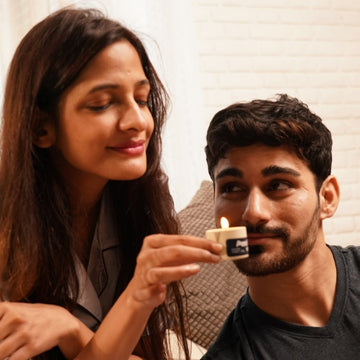
Your comfort matters, and there is no shame in preferring low lighting. However, complete darkness can become an avoidance behaviour that reinforces the belief that your body should not be seen. Therapists suggest working gradually toward more light: start with candles or dim lamplight. The goal is not flood lighting. It is being able to be seen without panic.
Can therapy help with body image during intimacy?
Absolutely. Cognitive Behavioural Therapy (CBT) is particularly effective for body image issues, as it directly addresses the thought patterns that drive spectatoring and avoidance. A therapist specialising in sexual health can combine body image work with intimacy-specific techniques for a comprehensive approach.
- Trusted by 3.75L+ Readers
- Expert-Backed Guidance
Pleasure Meets Quality
From massage oils to personal massagers, MyMuse makes products that celebrate real bodies. Delivered discreetly.
Explore the RangeLast updated: April 2026