




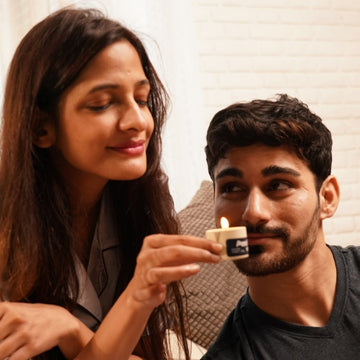





Sensory Play for Beginners: A Couples Guide

This content is for informational purposes only and does not constitute medical advice. Consult a healthcare professional for personal guidance.
You know that moment when your partner brushes past you in the kitchen and you catch their scent, that specific combination of soap and skin that's just them? Or when they trace their fingers along your arm absentmindedly while you're watching TV, and suddenly you're very aware of every nerve ending? That's sensory play, and you've probably been doing it without realizing it.
Most of us go through life on autopilot, especially in long-term relationships. We kiss the same way, touch the same spots, follow the same script. But our bodies are designed to respond to an incredible range of sensations, temperature, texture, pressure, scent, sound. When you intentionally play with these senses, you're not just adding variety. You're rewiring how you and your partner experience pleasure together.
The best part? You don't need a drawer full of equipment or an instruction manual. Sensory play is about curiosity, not performance. It's about slowing down enough to notice what actually feels good, not what you think is supposed to feel good.
Key Takeaways
- Sensory play involves deliberately engaging sight, sound, touch, taste, and smell to heighten intimacy and pleasure
- You don't need specialized products to start. Everyday items like ice cubes, fabric, and feathers work beautifully
- Removing one sense (like sight with a blindfold) naturally amplifies the others, creating new experiences
- The goal isn't intensity. It's variety and presence. Light touches often create more anticipation than firm pressure
- Communication before, during, and after is what makes sensory exploration safe and satisfying
What Sensory Play Actually Means
Sensory play is the practice of intentionally engaging one or more of your five senses to create new physical and emotional experiences with your partner. Instead of rushing toward a specific outcome, you're exploring what happens when you slow down and pay attention to sensation itself.
This isn't a new concept. Researchers studying human arousal have long known that our response to intimacy isn't just physical. It's deeply connected to context, novelty, and anticipation. When you introduce unexpected sensations, you're pulling your brain out of its usual patterns. You become more present. More attentive. More aware of your partner's responses.
Think of it like this: most intimate experiences follow a predictable sequence. Your brain knows what's coming next, so it processes everything efficiently. But when you introduce something unexpected, a sudden temperature change, an unfamiliar texture, a surprising sound, your nervous system perks up. You can't predict what comes next, so you pay closer attention to what's happening right now.
Why It Works (The Science Part)
Your skin contains thousands of different receptors that respond to pressure, temperature, pain, and pleasure. Most of the time, we only activate a small percentage of them. Sensory play is about waking up the others.
When you remove one sense, say, by using a blindfold, your brain automatically amplifies the others to compensate. Touch becomes more intense. Sounds feel closer. You notice your partner's breathing, the shift in temperature when they move near you, the specific pressure of their fingertips. Therapists who work with couples often recommend sensory exercises precisely because they force you to get out of your head and into your body.
There's also something powerful about the vulnerability of it. When you can't see what's coming next, you have to trust your partner. That trust, when honored, creates emotional intimacy that carries over long after the moment ends.
Starting Simple: The Five Senses
Touch (Where Most People Begin)
Temperature play is one of the easiest entry points. Try running an ice cube along your partner's collarbone, then following the same path with your warm breath. The contrast creates a kind of confusion in the nervous system that heightens sensitivity.
Texture is another option. A silk scarf feels completely different from a soft brush or your fingernails. Try varying pressure too, feather-light touches across sensitive skin often create more anticipation than firm strokes.
Sight (Or the Lack of It)
Blindfolds are sensory play 101 for a reason. When you remove sight, anticipation becomes part of the experience. Your partner doesn't know where you'll touch next, what temperature to expect, or what sensation is coming.
You don't need anything fancy, a soft sleep mask or even a folded scarf works perfectly. The goal is gentle darkness, not tight binding. Comfort matters more than drama.
Sound
This one's underrated. Your voice, especially whispered close to your partner's ear, can be incredibly powerful. So can deliberate silence, where the only sounds are breathing and movement.
Some couples create playlists specifically for intimate moments, choosing music that creates a particular mood without being distracting. Others use ambient sounds like rain or soft instrumental tracks to block out household noise and create a sense of separation from daily life.
Taste and Smell
These senses are deeply connected to memory and emotion, which is why certain scents can instantly shift your mood. Try using flavored massage oils, feeding each other small bites of chocolate or fruit, or just paying attention to your partner's natural scent.
In India especially, where we're surrounded by aromatic spices and flowers, incorporating familiar-but-special scents can create a comforting sense of occasion. Jasmine, sandalwood, rose: these aren't just pleasant smells, they're cultural touchstones that can make the experience feel both intimate and meaningful.
What You'll Need (Spoiler: Probably Less Than You Think)
You genuinely don't need to buy anything to start exploring sensory play. Look around your home first:
- Ice cubes and warm towels (temperature)
- Silk scarves, velvet fabric, soft brushes (texture)
- Feathers from an old pillow or craft store
- Coconut oil or shea butter for massage
- A sleep mask or folded scarf (blindfold)
- Your favorite playlist and a decent speaker
That said, if you do want something designed specifically for this purpose, a few thoughtfully chosen items can expand your options. Or something like a massage candle combines scent, warmth, and touch in one product. You light it, let it melt into warm oil, then use it for massage. The temperature is just warm enough to be noticeable without any risk of burns.
How to Actually Do This (A Starting Framework)
Talk First
This sounds obvious, but it's the step most people skip. Before you try anything, have a actual conversation about what interests you both. Are there textures that feel unpleasant? Areas that are off-limits? Things you're curious about but nervous to suggest? Establish a simple signal that means "pause" or "that's not working for me". It can be as simple as squeezing your partner's hand twice.
Set the Scene
You don't need candles and rose petals (though you can if that's your thing). What you do need is freedom from interruption. Lock the door. Silence your phones. If you have kids, wait until they're definitely asleep or out of the house. The goal is to create a bubble where you're not listening for footsteps or notifications.
Start Slow and Obvious
Don't try to incorporate all five senses at once. Pick one or two. Maybe you start with a blindfold and focus entirely on varying touch: different textures, temperatures, and pressures. Or you keep the lights on but introduce unexpected sounds or scents. Let yourselves be a bit awkward. Laugh when something doesn't work. Adjust as you go.
Pay Attention to Responses
The person receiving sensation should feel free to give feedback. What feels good, what's just okay, what they want more of. The person giving should watch for physical cues: changes in breathing, muscle tension, sounds. This isn't a performance. It's a conversation in a different language.
Debrief After
Once you're done (however you define "done"), take a few minutes to talk about what worked. What surprised you? What would you want to try again? What would you skip next time? This feedback loop is how you build a shared vocabulary around pleasure, and it makes the next experience even better.
Common Worries (And Why They're Usually Fine)
"What if I feel silly?" You probably will, at least a little. Most new things feel awkward until they don't. Give yourself permission to be a beginner. If you can laugh together when something feels ridiculous, you're actually building the kind of comfort that makes intimacy better.
"What if my partner isn't into it?" Then you've learned something valuable about their preferences, and you can explore other options together. Not everyone responds to the same kinds of stimulation, and that's completely fine. The point of exploring is to discover what works for both of you, not to follow someone else's script.
"Is this... normal?" Sensory play is one of the most common forms of intimate exploration. It's not edge-play or particularly adventurous. It's just a different way of paying attention to sensation. Therapists recommend it. Researchers study it. Millions of couples incorporate elements of it without calling it anything special.
"What about privacy and discretion?" This is a real concern in India, especially if you live in a joint family or have thin walls. The beauty of sensory play is that it doesn't require noise or elaborate setups. Most of it can happen in complete silence. If you're ordering any products online, discreet packaging and billing are standard with reputable brands, nothing on the outside of the box or your credit card statement will indicate what's inside.
Building From Here
Once you've tried the basics, you can layer in more complexity. Combine temperature with texture. Add scent to sound. Experiment with anticipation by making your partner wait between sensations. Introduce gentle restraint (like holding their wrists above their head) to amplify the feeling of surrender.
The goal isn't to work through a checklist. It's to stay curious. Every body responds differently, and every partnership has its own rhythm. What feels incredible one night might feel just okay another time. That's normal. You're not trying to achieve perfection. You're trying to stay interested and present.
Do we need to buy special products to try sensory play?
Not at all. Most people start with household items: ice cubes, scarves, feathers, coconut oil. The focus is on varying sensation, not on having specific equipment. That said, if you do want body-safe products designed for this purpose, a simple blindfold or massage candle can expand your options without cluttering your space.
What if one of us is more interested than the other?
Start with the elements that appeal to both of you. If your partner isn't interested in blindfolds but is curious about temperature or texture, begin there. Frame it as an experiment rather than a commitment: "want to try this once and see how it feels?" removes pressure and allows both of you to opt in at your comfort level.
How do we talk about boundaries without killing the mood?
Have those conversations before you're in the moment. Pick a relaxed time, maybe over tea or during a walk, and discuss what sounds interesting, what sounds like a hard no, and what falls in the "maybe" category. Once you've established those boundaries, you don't have to renegotiate them in real-time. You can just explore within the framework you've already agreed on.
Is sensory play safe during pregnancy?
Most sensory activities, like using different textures, temperatures, or blindfolds, are perfectly safe during pregnancy. The key is to prioritize comfort and avoid anything that causes physical strain or discomfort. Always follow your healthcare provider's specific guidance about intimate activities during pregnancy, but gentle sensory exploration is generally well within safe boundaries.
How often should we incorporate sensory play?
There's no schedule. Some couples weave small sensory elements, like a blindfold or temperature play, into regular intimate time. Others support it as something special they do occasionally when they have more time and privacy. Follow your interest rather than trying to maintain a specific frequency. The moment it feels like an obligation, you've missed the point.
The Bottom Line
Sensory play isn't about performing or checking boxes. It's about slowing down enough to notice what actually feels good, for both of you. You don't need special equipment, advanced techniques, or perfect conditions. You just need curiosity, communication, and a willingness to pay attention. Start simple, stay playful, and let yourselves be surprised by what you discover.
- 100% Body-Safe Materials
- Discreet Packaging & Billing
- Trusted by 3.75L+ Customers
- 100-Day Warranty
- 100% Body-Safe Materials (Platinum-Grade Silicone)
- Discreet Packaging & Billing
- Trusted by 3.75L+ Customers Across 1,900+ Cities
- 100-Day Warranty on All Products
Last updated: April 2026