









How to Talk About It When the Sex Was... Not Great

This content is for informational purposes only and does not constitute medical advice. Consult a healthcare professional for personal guidance.
Key Takeaways
- Unsatisfying intimate experiences are normal and not a reflection of your relationship's health
- The conversation after matters more than the experience itself -- couples who talk improve, those who do not stagnate
- Timing, framing, and specificity are the three pillars of effective post-intimacy communication
- Criticism shuts people down; curiosity opens them up
- The goal is not to assign blame but to co-create better experiences going forward
It was fine. Not terrible, not great. Just... fine. Or maybe it was not even fine. Maybe it was awkward, or uncomfortable, or left one or both of you feeling disconnected rather than close. And now you are lying there in the dark, deciding whether to say something or just pretend it did not happen.
If this sounds familiar, you are in vast and silent company. Unsatisfying intimate experiences happen in every relationship, including the happiest ones. The difference between couples who gradually improve their intimacy and those whose intimate life slowly withers is not that the first group never has a bad experience. It is that they are willing to talk about it afterward.
In India, where open conversations about intimacy are rare even between partners, the idea of debriefing a disappointing experience feels almost radical. But it is also one of the most powerful things you can do for your relationship. Here is how to have that conversation without destroying the mood, the relationship, or your partner's confidence.
First: Normalise the Reality
Before we talk about how to have the conversation, let us establish something important: not every intimate encounter will be spectacular. This is true for every couple, always. The idea that intimacy should be consistently mind-blowing is a fiction created by unrealistic portrayals in media and a complete absence of honest conversation.
Intimacy is influenced by energy levels, stress, hormones, mood, physical comfort, timing, and a dozen other variables that change daily. Some nights everything aligns and the experience feels transcendent. Other nights, you are both exhausted, distracted, or simply not on the same wavelength. Neither outcome says anything definitive about your relationship or your compatibility.
The problem is not that bad experiences happen. The problem is what we do with them. If every unsatisfying encounter gets buried under silence and forced normalcy, patterns solidify. Small disconnections become large ones. One partner's unspoken preferences remain unknown. The other partner's uncertainty about what works grows into avoidance.
The Timing Question: When to Talk
Timing is everything in these conversations, and the right timing depends on the situation.
Not during. Unless something is actively uncomfortable or painful (in which case, speak up immediately), mid-experience is not the time for a detailed performance review. The vulnerability of the moment makes criticism feel devastating. The exception is positive direction -- "I love it when you do this" or "Can you try going slower?" -- which is welcome and helpful in real time.
Not immediately after. The post-intimacy window is tender. Both partners are physically and emotionally exposed. Launching into "So that did not really work for me" while you are both still catching your breath is likely to feel like an ambush. Give yourselves a cushion of warmth and reconnection first.
The sweet spot: within 24-48 hours. Choose a neutral moment when you are both relaxed, clothed, and not in the bedroom. Over chai in the morning. During a walk. On a drive. The physical setting matters -- moving the conversation out of the bedroom removes the immediate association with performance and makes it feel more like a normal discussion between partners.
The Framework: How to Say It
Lead With Positive Intent
Start by framing the conversation as something you are doing because you care about the relationship, not because you want to complain. "I want to talk about something because our intimate life matters to me and I want us to keep getting better at it" is a very different opening than "We need to talk about last night."
Use "I" Statements, Not "You" Statements
This is relationship communication 101, but it is especially important here where egos are fragile. "I felt disconnected last night" lands very differently from "You were not present last night." "I was not able to relax" is easier to hear than "You were rushing." The experience is the same, but "I" statements share your experience while "you" statements assign blame.
Be Specific, Not Vague
Vague feedback is useless feedback. "It was not great" gives your partner nothing to work with and everything to worry about. Specificity is a gift: "I noticed I was not as aroused as usual -- I think I needed more time warming up" or "The position we tried was not comfortable for me" gives your partner clear, actionable information.
Redirect Toward What You Want
The most effective conversations spend more time on what you want than on what went wrong. Instead of a detailed analysis of the unsatisfying experience, pivot toward the future: "I would love it if we spent more time on foreplay next time" or "I realised that I really enjoy it when we go slowly at the beginning -- can we try that?"
Ask Questions
Make it a dialogue, not a monologue. "How did you feel about last night?" invites your partner into the conversation. "Is there anything you have been wanting to try?" opens the door to their unspoken desires. "What do I do that you love most?" focuses on strengths. These questions signal that you are interested in their experience, not just broadcasting your own.
Scripts for Common Situations
When You Did Not Enjoy It
"I was thinking about last night and I want to be honest with you because I value our intimacy. I was not fully into it, and I think it was because I was really stressed from work. It was not about you at all. But I would love for us to find a way to help me transition out of work mode before we connect physically. Maybe a massage, or even just fifteen minutes of cuddling and chatting first?"
When Something Specific Did Not Work
"I love being intimate with you, and I want to share something that I think will make it even better. That position we tried -- it was not quite comfortable for me. It put pressure in the wrong place. Can we try a different angle next time? I think if my hips were supported with a pillow it would be much better."
When You Want More Foreplay
"You know what I have been thinking about? How much I enjoy the beginning of our intimate time -- the kissing, the touching, the build-up. I would love for us to extend that part more. It helps me get fully into my body, and I think it would make the whole experience more intense for both of us."
When Your Partner Seems Disconnected
"I noticed last night that you seemed like your mind was somewhere else. I just want to check in -- is everything okay? Is there anything I can do differently, or anything going on that is making it hard to be present? No pressure to answer right now, but I care about how you are feeling."
What Not to Do
- Do not compare. "My ex used to do this differently" or "I read online that most people..." is a conversation killer. Your intimate life exists between two specific people. External comparisons introduce shame and defensiveness.
- Do not use humour to deflect. Cracking jokes about a disappointing experience might feel safer than honesty, but it signals that the topic is not worth taking seriously. If you use humour, make sure the real message still lands.
- Do not accumulate grievances. If you silently bank every unsatisfying experience and then unload them in a single conversation, your partner will feel ambushed. Address things as they come up, in small, manageable conversations.
- Do not globalise. "You never" and "you always" are the enemies of productive conversation. Stick to the specific experience you want to discuss.
- Do not withhold intimacy as punishment. Using the silent treatment or withdrawing physically because you are unhappy but unwilling to communicate creates a toxic cycle that benefits no one.
Building a Feedback Culture
The goal is not to have one big, difficult conversation. It is to build a relationship culture where talking about intimacy is normal, ongoing, and low-stakes. Couples who do this well have regular, casual check-ins rather than rare, intense confrontations.
Some couples find it helpful to establish a monthly "intimacy check-in" -- a dedicated time to talk about what is working, what they would like more of, and what they want to explore. Others integrate it into daily life with small, frequent touches: "I loved when you did that this morning" or "I want to try that thing we talked about -- what do you think?"
The more frequently you have these conversations, the less charged each one feels. It becomes normal. Expected. Even exciting. Because the conversations are not just about fixing what is broken -- they are also about discovering what is possible. What new things might you enjoy? What fantasies have you not shared? What would make your intimate life not just satisfactory but genuinely thrilling?
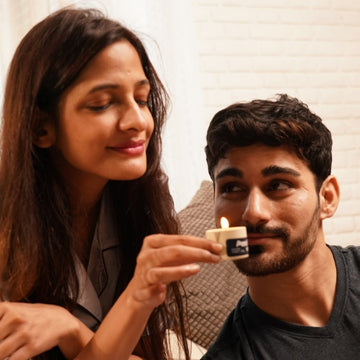
Sometimes, practical tools help bridge the gap. A shared intimate experience that is new to both partners -- like introducing a couples product such as the MyMuse Melt massage candle -- can serve as a natural conversation starter, giving you both something to react to and discuss without the pressure of personal critique.
Frequently asked questions
What if my partner gets defensive when I try to talk about intimacy?
Defensiveness usually comes from fear of inadequacy. Reassure your partner that the conversation comes from a place of care, not criticism. Start with what you appreciate before sharing what you would like to change. If defensiveness persists, suggest framing the conversation as mutual exploration rather than one-sided feedback -- "Let us both share one thing we love and one thing we would like to try differently."
Is it okay to fake enjoyment to avoid hurting my partner's feelings?
Occasional kindness about a minor issue is human. But consistently faking enjoyment creates a false map that leads your partner further from what actually works for you. Over time, the gap between their understanding of your pleasure and your actual experience widens, making honest conversation harder and satisfaction more elusive. Gentle honesty now prevents bigger problems later.
How do I bring up wanting to try something new without making my partner feel like what we have is not enough?
Frame it as adding to your repertoire rather than replacing what exists. "I love what we do, and I am also curious about trying..." positions it as expansion, not correction. You might also share the idea as something you saw or read about, removing the pressure of it being a personal critique: "I came across this idea and it sounded interesting -- would you be open to exploring it together?"
We have been married for years and never talked about this. Is it too late to start?
It is never too late. In fact, couples who begin these conversations later in their relationships often experience dramatic improvements precisely because the gap between current reality and potential is wide. Start small. You do not need to address every issue in one conversation. Begin with something positive -- "I really enjoy when we..." -- and build from there.
What if the problem is that I simply do not enjoy intimacy with my partner anymore?
This is worth exploring with curiosity rather than panic. Has desire changed, or has it disappeared? Are there unresolved relationship issues dampening attraction? Has stress, health, or medication played a role? A sex therapist can help untangle the factors. Often, what feels like permanent loss of desire is actually a response to specific, addressable conditions.
- Expert-Informed Advice
- Reviewed by Relationship Therapists
- Discreet Packaging on All Orders
- Trusted by 3.75L+ Customers
Start Your Journey
Great intimacy starts with great communication -- and sometimes, a little something new. Explore MyMuse's couples collection for products designed to spark conversation and connection.
Explore the RangeLast updated: April 2026